5 External Barriers II
Topic 5: External Barriers - Intermediate
Introduction
The Bare Essentials of this topic gave you a map of the terrain — the major categories of external barriers and how they work. That map is accurate and useful. But like any map, it simplifies. It shows you what the barriers are without fully capturing how they behave in the real world: how they overlap, how they multiply, how they become invisible to people who don’t face them, and what it actually costs to navigate them day after day.
That’s what this level is for. Not more categories, but sharper vision.
Topics 4 and 5 are companion pieces. Topic 4 looked at what happens inside a person when barriers take hold — how external pressures get absorbed and become part of how someone sees themselves. This topic stays on the outside, but looks more carefully at the structures and forces themselves: how they’re organized, how they compound, and why they’re so often invisible to people who aren’t affected by them.
Two frameworks introduced here — intersectionality and privilege — are among the most useful analytical tools available for understanding why external barriers hit different people so differently. They can generate strong reactions, so it’s worth saying upfront: both are descriptive tools, not moral verdicts. The goal isn’t to assign guilt or grievance. It’s to see clearly.
Because that’s ultimately what this whole level is about. External barriers are often hard to see — either because you don’t face them yourself, or because you’re so deep inside them that they feel like the natural order of things rather than obstacles that were built and can be changed. The clearer you can see them, the better equipped you are — and the better equipped the people around you are — to do something about them.
Intersectionality: When Barriers Multiply
In 1989, legal scholar Kimberlé Crenshaw introduced the concept of intersectionality to describe something she had observed in discrimination law: that Black women were falling through the cracks of legal frameworks that dealt with race and gender separately.
The problem was this. If a company discriminated against Black women specifically — hiring Black men and white women but not Black women — it could escape liability under both race discrimination law and sex discrimination law, because it wasn’t discriminating against all Black people or all women. The discrimination was happening at the intersection of race and gender, and neither framework alone could see it.
Crenshaw named this using a metaphor that has since become widely used: an intersection. If you’re standing at a crossroads and get hit by a car, it doesn’t really matter which street the car came from — what matters is that you got hit. And if traffic is coming from multiple directions simultaneously, the experience is not simply “car from street A” plus “car from street B.” It’s something more complex and more dangerous than either alone.
flowchart TD
    A["Racial Discrimination"] --> E
    B["Gender Discrimination"] --> E
    C["Economic Barriers"] --> E
    D["Disability / Neurodivergence\nBarriers"] --> E
    E(["Person at the Intersection"])
    E --> F["Experience not fully captured\nby any single dimension alone"]
What intersectionality means in practice
The core insight is this: people don’t experience barriers one at a time. They experience them simultaneously, and the combination creates something qualitatively different — not just more barriers, but different ones.
Consider a few examples:
A Black woman in a professional workplace may face discrimination that isn’t fully captured by either the experience of Black men or white women. Black men and white women each face significant barriers, but the specific combination of racism and sexism creates a distinct set of experiences — particular stereotypes, particular patterns of being overlooked or over-scrutinized — that neither group’s experience fully predicts.
An elderly immigrant with a disability navigating a healthcare system faces economic barriers, language barriers, age-related bias, disability-related access barriers, and cultural barriers simultaneously. These don’t line up neatly. Solving one doesn’t solve the others. Solutions designed for one dimension — translated medical forms, for instance — may still leave the person unable to navigate a system that isn’t designed for their mobility needs or economic situation.
A young person from a low-income background who is also LGBTQ+ may face economic barriers that are significantly worsened by family rejection — losing the financial support, housing, and network that other young people can rely on while establishing themselves.
Why this matters beyond individual experience
Intersectionality isn’t just a framework for understanding individual situations — it’s a tool for understanding why well-intentioned solutions often fail the people who need them most. A program designed to address poverty without considering race, gender, or disability may work reasonably well for a narrow set of people while leaving others behind. A workplace diversity initiative focused only on gender representation may improve outcomes for white women while doing little for women of color.
This isn’t an argument that such efforts are worthless. It’s an argument that single-axis thinking — seeing only one dimension of a person’s barrier landscape — produces incomplete solutions. The more dimensions you can see simultaneously, the more accurately you understand what someone is actually up against.
A note on complexity
Intersectionality can feel overwhelming when first encountered, because it seems to suggest that every situation is uniquely complex and no generalizations are possible. In practice it’s more manageable than that. You don’t need to map every possible combination of barriers before acting. What you do need is the habit of asking: am I seeing the full picture here, or am I only seeing one dimension? That question, applied consistently, takes you a long way.
Privilege: The Absence of Barriers
Few words generate more defensive reactions than “privilege.” It’s worth starting by setting aside the version of the concept that tends to produce those reactions — the idea that having privilege means your life is easy, that you haven’t worked hard, or that you owe something. That’s not what the term means in this context, and that framing isn’t useful here.
In the context of external barriers, privilege simply means the absence of a specific barrier. Nothing more and nothing less.
If you’ve never had to wonder whether a building has an accessible entrance, you have a form of privilege relative to people who navigate that question every time they leave the house. If English is your first language and all the institutions you interact with operate in English, you’re not experiencing a language barrier that others face daily. If your name reads as belonging to the dominant cultural group on a job application, you’re not experiencing the documented pattern of callbacks dropping significantly for names that don’t. These aren’t moral statements. They’re descriptions of who faces which obstacles.
Why privilege is invisible
The most important thing to understand about privilege is why it’s hard to see: you generally can’t perceive a barrier you don’t face.
If you’ve always had reliable internet access, slow or absent internet doesn’t register as a significant obstacle — it’s just not part of your experience. If you’ve never been followed around a shop by security staff, it can be genuinely hard to believe it happens as regularly as it does. If your neurotype fits comfortably within the expectations of your workplace or school, the exhausting effort of people who don’t fit those expectations — who spend significant energy every day appearing to function in a way that doesn’t come naturally — is simply invisible to you.
This isn’t a failure of empathy or imagination, though empathy and imagination can help. It’s a structural feature of how experience works. You can only directly perceive what you encounter. Everything else requires either testimony from people who do encounter it, or deliberate effort to look for what you’re not seeing.
This is why privilege matters for seeing clearly. If you’re trying to understand why someone is struggling, or why a system isn’t working for certain people, or why an opportunity that seems obvious to you isn’t being taken — and you’re only looking through the lens of your own experience — you’ll systematically miss things. Not because you’re bad at observing, but because your experience doesn’t include the relevant data.
Privilege isn’t all-or-nothing
Almost no one is privileged in every dimension or disadvantaged in every dimension. The same person can have significant advantages in some areas of their life while facing real barriers in others. A wealthy person of color has economic resources that buffer some barriers while still facing racial discrimination. A white person with a disability has some barriers removed while facing others. A neurotypical person from a low-income background doesn’t face the barriers of neurodivergence but does face economic ones.
This matters because “you have privilege” is rarely a complete description of anyone’s situation — and treating it as one shuts down rather than opens up understanding. The useful question isn’t “do you have privilege?” but rather “in which dimensions, relative to whom, and what does that mean for what you can and can’t see clearly?”
What to do with this
Recognizing your own areas of privilege doesn’t require guilt, and it doesn’t require self-flagellation. What it does require is a willingness to treat your own experience as incomplete data — to take seriously the possibility that things you haven’t personally encountered are real, significant, and worth understanding.
For some people this is easy. For others it feels threatening, because privilege can become entangled with identity — if I acknowledge that some of my success came from circumstances rather than purely from effort, does that diminish what I’ve achieved? The honest answer is: no. Effort is real. Circumstances are also real. Both things are true simultaneously. Acknowledging the role of circumstance doesn’t erase the role of effort — it just gives you a more accurate picture of how things actually work.
Structural vs. Individual: Two Different Problems
When most people think of discrimination, they picture an individual act: a hiring manager who doesn’t hire someone because of their race, a landlord who refuses to rent to someone because of their religion, a teacher who treats a student differently because of their gender. This is real, it matters, and it causes genuine harm.
But it’s only part of the picture.
Structural discrimination is something different. It refers to patterns built into institutions, policies, systems, and norms that produce discriminatory outcomes — not necessarily because any individual intended them to, but because of how the system is designed or how it has evolved.
The distinction matters enormously for understanding external barriers, because the two problems have different causes, different shapes, and require different responses.
What structural barriers look like
A few concrete examples help make the concept tangible:
School funding tied to property taxes. In many places, public schools are funded primarily through local property taxes. Wealthier neighborhoods have higher property values, which generates more tax revenue, which funds better-resourced schools. Poorer neighborhoods generate less revenue and get less-resourced schools. No individual has to intend this outcome for it to consistently produce it, year after year. The structure does it automatically.
Resume screening and name discrimination. Research studies have repeatedly sent identical resumes to employers, varying only the name at the top — some names common in certain ethnic groups, others common in others. The resumes with names perceived as belonging to dominant cultural groups consistently receive significantly more callbacks, despite being identical in every other respect. Many of the hiring managers involved likely consider themselves fair-minded. The bias is operating below the level of conscious intent.
Criminal records and employment. A person who has served their sentence for a past offense — often a minor one — encounters a structural barrier: the majority of employers screen out applicants with criminal records, regardless of what the offense was, how long ago it occurred, or how relevant it is to the job. This isn’t one employer’s prejudice. It’s a widespread structural feature of hiring that functions as a near-permanent barrier to economic participation.
Neurotypical norms in workplaces and schools. Most workplaces and educational institutions were designed around assumptions about how people communicate, focus, process information, and behave socially — assumptions that reflect neurotypical experience. Neurodiverse people may face structural barriers not because any individual is deliberately excluding them, but because the system simply wasn’t built with them in mind. (For more on neurodivergence itself, see Level 2: Psychology.)
The “I’m not prejudiced” problem
One of the most common responses to discussions of structural discrimination is: “I’m not personally prejudiced, so I’m not part of the problem.” This response makes sense as a defense against individual blame — and it’s true that individual prejudice and structural discrimination are different things.
But it misses the point. A structure doesn’t need prejudiced individuals to maintain it. It maintains itself through the accumulated weight of policies, norms, incentives, and habits. A well-meaning person operating within a structurally biased system will often produce biased outcomes without intending to — simply by following the rules of the system as they find it.
This isn’t an argument that individual attitudes don’t matter. They do. Changing individual attitudes is part of how structural change happens. The point is that focusing exclusively on individual attitudes — assuming that if we could just eliminate personal prejudice, the problem would be solved — consistently underestimates how deeply structural factors shape outcomes.
Why this matters for understanding barriers
The practical reason to understand this distinction is that the type of problem determines what will actually address it.
If someone faces a barrier because of individual prejudice, addressing that specific person’s attitudes or behavior may help. If someone faces a structural barrier, the solution requires changing the structure — policy, institutional practice, incentive systems. Trying to solve a structural problem by changing individual attitudes is a bit like trying to empty a flooding room with a cup while the pipe is still broken. You’re not wrong that removing water helps, but you’re not addressing the source.
For someone navigating these barriers personally, this distinction also carries psychological weight. When you understand that a barrier you face is structural rather than a reflection of your individual worth, it becomes possible to separate the obstacle from your identity — to see it as something built by circumstances and maintained by systems, not as a verdict on you.
The Hidden Cost: How External Barriers Get Inside
External barriers don’t just block paths. They cost something every time you encounter them — in energy, attention, stress, and health. And when those encounters are frequent enough, chronic enough, the cost doesn’t stay external. It gets inside.
This section is the bridge between Topics 4 and 5. Topic 4 covered how external pressure becomes internal barrier through the internalization pathway — how messages absorbed over time reshape identity and belief. What we’re looking at here is a different but related process: not the slow absorption of messages, but the immediate, cumulative physiological and psychological toll of navigating a world that creates extra friction for you specifically.
The exhaustion of navigation
Every barrier you face requires energy to deal with — even when you handle it successfully. Having to research whether a venue is wheelchair accessible before every outing. Having to decide, in a split second, whether to disclose a disability or mental health condition to an employer. Having to calculate how much of yourself to reveal in a given social context. Having to monitor how you’re being perceived and adjust accordingly.
For people who don’t face these barriers, these calculations simply don’t happen. They move through the world with a degree of frictionlessness that they typically don’t notice because it’s all they’ve ever known. For people who do face them, the calculations are constant — and they consume cognitive and emotional resources that would otherwise be available for everything else.
Researchers studying poverty and cognitive load have found that the mental effort of managing scarcity — constantly calculating what you can afford, what trade-offs to make, what risks you can take — measurably reduces cognitive bandwidth available for other decisions and tasks. The same principle applies more broadly: navigating barriers takes up mental space. That space isn’t available for learning, creativity, planning, or the kind of sustained attention that skill development requires.
Chronic stress and the body
The human stress response evolved to handle short-term threats. When a threat appears, the body activates — heart rate rises, focus sharpens, energy mobilizes. When the threat passes, the system calms down.
This works well for acute stress. It works poorly for chronic stress — sustained, ongoing exposure to difficult conditions — because the system stays partially activated indefinitely. The accumulated physiological toll of chronic stress is called allostatic load, and it has measurable effects: elevated risk of cardiovascular disease, weakened immune function, disrupted sleep, accelerated cellular aging.
Researcher Arline Geronimus documented this specifically in the context of racial discrimination in the United States, finding that the chronic stress of navigating racism contributed to measurably worse health outcomes for Black Americans across economic classes — including those who were financially comfortable. She called this weathering: the body aging faster under the sustained burden of discrimination, regardless of individual circumstances. This is one of the clearest demonstrations that external barriers are not just inconveniences or missed opportunities — they are physical forces acting on the body over time.
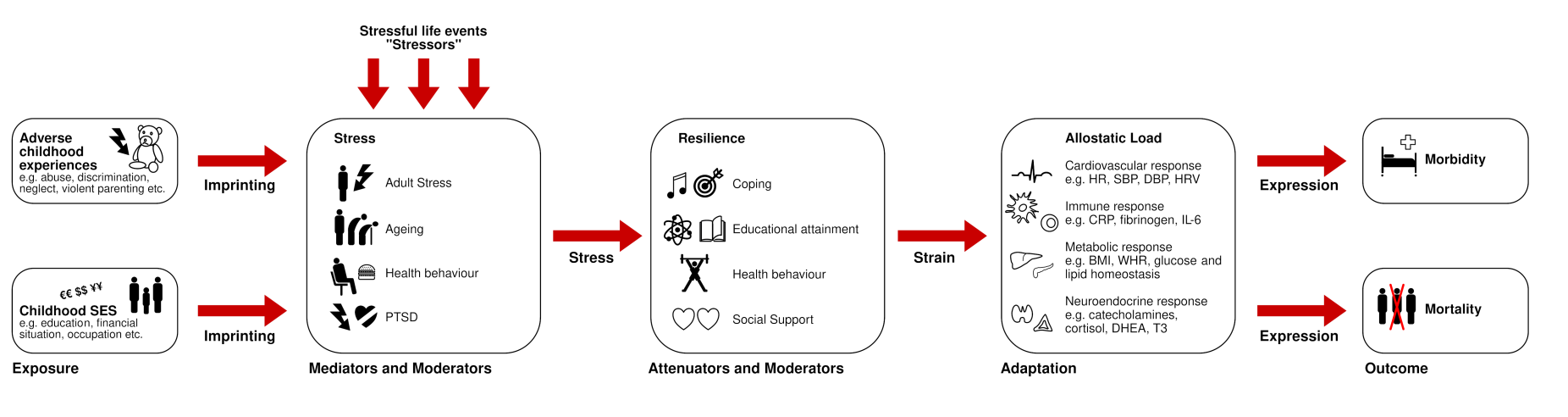
This diagram maps the pathway from adverse childhood experiences and socioeconomic circumstances (left) through stress responses and resilience factors to measurable physiological outcomes (right). The technical terms in the Allostatic Load column refer to markers in different body systems — cardiovascular, immune, metabolic, and hormonal — that chronic stress measurably affects over time. What’s worth noticing in the middle column (Attenuators and Moderators) is that coping skills, educational attainment, health behaviour, and social support all sit directly in the pathway between stress and its physical consequences — moderating the outcome. These are precisely the kinds of capacities this program is designed to build. Jwdietrich2, CC BY 4.0, via Wikimedia Commons

Stereotype threat
The Bare Essentials introduced stereotype threat: the phenomenon where awareness of negative stereotypes about your group actually impairs performance, not because the stereotype is true, but because the awareness itself creates cognitive and emotional interference.
This is worth dwelling on because it demonstrates the external-to-internal pathway in real time — not gradually over years, but in the moment. A student who is aware that their group is stereotyped as less capable in mathematics enters a test carrying that awareness as an additional cognitive burden. Managing it — suppressing anxiety, monitoring performance, working to disprove the stereotype — consumes resources that their peers, who don’t carry that burden, can allocate entirely to the test itself. The external discrimination that produced the stereotype doesn’t need to be present in the room. The knowledge of it is enough.
Masking
For neurodiverse people, a specific and significant hidden cost deserves naming: masking. This refers to the effort of suppressing or concealing natural neurodiverse traits — particular ways of moving, stimming, communicating, processing, or responding — in order to appear neurotypical in social and professional settings.
Masking is exhausting in a way that’s difficult to convey to people who don’t do it. It requires sustained, conscious monitoring of behaviour that neurotypical people manage automatically. Many neurodiverse people describe going through an entire workday appearing composed and functional, then experiencing significant fatigue or emotional dysregulation afterward — sometimes called an “autistic burnout” — that is invisible to the people around them. (For more on neurodivergence, see Level 2: Psychology.)
The cost of masking is hidden precisely because it works. The person appears fine. The barrier is therefore invisible to everyone except the person paying its price.
Cumulative effects
One of the hardest things to communicate about these hidden costs is that they’re cumulative. It’s not one barrier, one stressful encounter, one moment of stereotype threat. It’s thousands of them, over years and decades, in contexts that range from trivial to life-altering. Any single instance might seem manageable — and often is. The accumulated weight is something different.
This is another dimension that privilege makes invisible. Someone who doesn’t face these barriers doesn’t just avoid individual difficult moments. They avoid the compounding of those moments over a lifetime. The gap between their experience and the experience of someone who does face them isn’t the sum of individual incidents — it’s the difference between a path with and without constant friction, walked over many years.
The connection to Topic 4
All of this ultimately leads back to what Topic 4 covered: external barriers don’t stay external. Chronic stress affects cognition and emotion. Constant navigation depletes the resources needed for growth and learning. Stereotype threat turns external discrimination into impaired performance in the moment. Masking turns structural non-accommodation into daily exhaustion.
And over time, as Topic 4’s internalization pathway described, these external forces shape how people see themselves. The message that the world sends — this isn’t designed for you, you don’t belong here, you have to work harder just to be seen as adequate — can become, quietly, a belief. Not because it was ever true, but because it was repeated often enough, in enough contexts, with enough weight behind it.
Understanding this connection doesn’t dissolve the barriers. But it makes visible something that is usually invisible: the full cost of what people navigating significant external barriers are actually carrying.
How Barriers Cluster
External barriers don’t distribute themselves evenly or randomly across people’s lives. They cluster — gathering together in ways that mean the people facing the most significant barriers rarely face just one.
This is distinct from intersectionality, which is about how multiple dimensions of identity produce compounding experiences. Clustering is about how circumstantial and structural barriers tend to co-occur — how poverty brings several other barriers with it, how geographic isolation comes packaged with limited healthcare and education, how one disadvantage tends to make several others more likely.
Poverty as the central example
Poverty is the most studied and most visible example of barrier clustering, because economic barriers don’t arrive alone. They tend to bring:
- Educational barriers: Underfunded schools concentrated in low-income areas, less access to technology and enrichment, higher rates of disruption to schooling
- Healthcare barriers: Less access to preventative care, more untreated conditions, higher rates of stress-related illness
- Geographic barriers: Concentration in areas with fewer job opportunities, less public investment, more environmental hazards
- Transportation barriers: Less ability to access opportunities outside the immediate area
- Family and social barriers: Higher rates of family stress, instability, and caregiving demands that compete with education and work
- Time barriers: Working multiple jobs or long hours leaves little time for education, skill-building, or civic participation
None of these is poverty itself — but all of them reliably travel with it. The result is that someone navigating poverty is typically navigating six or seven significant barriers simultaneously, not one. The advice to “just get an education” or “just get a better job” — offered as if these are simple steps — often fails to account for how many other barriers make those steps difficult to access.
mindmap
  root((Poverty))
    Educational Barriers
      Underfunded schools
      Limited technology access
      Disrupted schooling
    Healthcare Barriers
      Limited preventative care
      Untreated conditions
      Stress-related illness
    Geographic Barriers
      Disinvestment
      Environmental hazards
    Transportation Barriers
      Limited mobility
      Cut off from opportunity
    Family and Social Barriers
      Household stress
      Caregiving demands
    Time Barriers
      Multiple jobs
      Limited capacity for growth
There’s also a geographic dimension to this clustering. Concentrated disadvantage — the tendency for poverty, under-resourced schools, environmental hazards, higher crime, and limited services to concentrate in the same neighborhoods rather than distributing themselves evenly — means that where you grow up has significant effects on your outcomes independent of your individual circumstances. Children in high-poverty neighborhoods face a set of structural conditions that actively make advancement harder, regardless of their individual capabilities.
Other cluster examples
Poverty is the most visible cluster, but it’s not the only one:
Geographic isolation brings limited employment, limited transportation, limited educational options, limited healthcare, often limited internet access, and social isolation — all at once. Rural communities frequently experience this cluster.
Disability often clusters with healthcare barriers (needing more care while facing more barriers to accessing it), employment barriers (discrimination plus inaccessibility), economic barriers (disability frequently reduces earning capacity while increasing costs), and social isolation. For neurodiverse people specifically, the absence of early diagnosis often means years of struggling through educational and social systems without appropriate support — which compounds into qualification gaps, employment difficulties, and economic barriers that persist long after the original structural failure.
Criminal record clusters with employment barriers, housing barriers, educational barriers (many programs exclude people with records), loss of civic participation rights in many jurisdictions, and the social stigma that affects relationships and networks. The original circumstance — often a minor offense, often from years ago, often concentrated among already-disadvantaged populations — generates a sustained cluster of barriers that can last decades.
Why clustering matters
Understanding clustering changes how you interpret struggle. When someone is dealing with a cluster of barriers, their situation is not the sum of individual obstacles that could be addressed one at a time. It’s a system of mutually reinforcing disadvantages. Addressing one without addressing the others often produces limited results — not because the person isn’t trying or isn’t capable, but because the remaining barriers continue to constrain what’s possible.
This is why single-issue interventions frequently underperform their promise. A programme that provides access to education without addressing childcare, transportation, or income support may find that uptake is low — not because people don’t value education, but because the cluster of barriers around it makes access practically impossible despite the programme’s existence.
It also explains why “just work harder” or “just make better choices” advice — while not entirely without merit in certain contexts — often misses the structural reality of what people are navigating. Effort matters. Individual decisions matter. But effort and good decisions deployed against a cluster of structural barriers produce different outcomes than the same effort and decisions deployed in their absence. Acknowledging this isn’t making excuses. It’s accurate analysis.
Case Studies: Communities That Pushed Back
Understanding external barriers is one thing. Seeing what happens when people collectively decide to address them is another. The following case studies are drawn from different cultural contexts and different types of barriers, but they share a common thread: the recognition that barriers created by human decisions can be challenged by human action.
These examples are chosen for what they demonstrate about how communities push back, not as perfect models. Each has limitations, critics, and unresolved challenges. That’s part of what makes them realistic rather than inspirational mythology.
Grameen Bank and the Access to Capital Barrier (Bangladesh, 1983–present)
In rural Bangladesh in the 1970s and 1980s, poor people — and particularly poor women — faced an almost complete structural barrier to credit. Traditional banks required collateral; people in poverty had none. Without credit, starting a small business, buying tools, or building any kind of economic foundation was impossible. Poverty was, in this sense, self-reinforcing: you needed capital to escape poverty, but poverty prevented access to capital.
Economist Muhammad Yunus developed a model that worked around this structural barrier by replacing material collateral with social collateral. Borrowers formed small peer groups who were collectively responsible for each other’s repayments — creating accountability and mutual support rather than requiring property as security. Loans were small, targeted at specific income-generating activities, and extended primarily to women, who research showed invested earnings back into household and community wellbeing at higher rates than men.
The Grameen Bank, formalized in 1983, demonstrated that the assumption built into conventional banking — that poor people were too high-risk to lend to — was itself a structural barrier rather than an economic reality. Repayment rates were high. The model spread internationally and contributed to a global microcredit movement.
The lesson isn’t that microcredit solves poverty — research on its effects is more mixed than early enthusiasm suggested, and it has genuine limitations and critics. The lesson is that what looked like an immovable financial reality was actually a structural assumption that could be redesigned. The barrier wasn’t poverty itself but a system built on a false premise about who was creditworthy.
The Disability Rights Movement and the Americans with Disabilities Act (United States, 1970s–1990)
For most of the twentieth century, people with disabilities in the United States faced a comprehensive cluster of structural barriers: inaccessible buildings, no legal right to education in mainstream schools, employment discrimination with no legal remedy, and a pervasive cultural assumption — embedded in institutional design — that disabled people would either be institutionalized or cared for at home, not participate in public life.
The Independent Living Movement, pioneered in the late 1960s and 1970s by activists including Ed Roberts — who had used an iron lung since childhood and became the first severely disabled student admitted to the University of California, Berkeley — rejected the medical model’s framing of disability as something to be managed by institutions and professionals. Instead, it argued that disabled people were the experts on their own needs and had the right to self-determination in their own lives.
Over two decades, disability rights activists organized, testified, litigated, and protested. In 1990, hundreds of wheelchair users abandoned their chairs and crawled up the steps of the United States Capitol — a deliberate demonstration that the steps themselves were the barrier — as Congress debated the Americans with Disabilities Act. The ADA passed that year, requiring accessible buildings, workplaces, and public services, and prohibiting discrimination in employment.
This example is significant because it demonstrates structural change through collective advocacy. The barriers weren’t accidents — they were consequences of design choices made without disabled people in the room. Changing them required organizing, sustained effort over years, and ultimately changing law. Individual adaptation to inaccessible buildings was never going to solve the problem. Changing the buildings did.
The ADA is also imperfect — enforcement has been uneven, many barriers persist, and the movement’s work continues. But the trajectory from near-total exclusion to legal protection is a clear demonstration of what collective action directed at structural barriers can achieve.
The Kerala Model: Public Investment Breaking the Cluster (India, twentieth century–present)
The Indian state of Kerala presents an unusual case study in how public investment can break the barrier cluster that typically travels with poverty.
By conventional economic measures, Kerala is a relatively poor state. Its per-capita income has historically been modest compared to more industrialized Indian states. By human development measures — life expectancy, literacy rates, infant mortality, educational attainment — it has consistently outperformed not just the rest of India but many countries with significantly higher average incomes.
The explanation lies in deliberate public policy choices made over decades: sustained investment in universal education and healthcare, land reform that redistributed agricultural land more equitably, and active support for a strong civil society. These weren’t the automatic products of economic growth — they preceded and enabled it.
What makes Kerala instructive for understanding barrier clusters is precisely this inversion of the usual logic. Conventionally, economic development is expected to produce improvements in health and education. In Kerala, improvements in health and education produced economic development — and did so because they dismantled the cluster of barriers that typically makes poverty self-reinforcing. Literate populations make better health decisions. Educated women have greater economic participation and agency. Healthy children learn better. Communities with strong social institutions organize more effectively around shared problems.
Kerala’s model is not without complexity — it has faced economic migration, environmental challenges, and political tensions across its history. But it remains one of the clearest real-world demonstrations that the barrier cluster isn’t an inevitable feature of low-income societies. It’s a consequence of what gets invested in, and what gets left out.
What these examples share
Three different contexts, three different approaches — financial innovation, legal advocacy, public policy — and three different barrier types. But each demonstrates the same underlying point: external barriers are structures, and structures can be changed. Not easily, not quickly, and not by individuals acting alone. But changed.
Each also illustrates something we’ll return to in Level 3: change tends to happen when enough people understand the structural nature of the problem clearly enough to act on the structure rather than on its symptoms.
The Full Picture: Internal and External Together
Topics 4 and 5 have been covering two halves of the same reality. It’s worth stepping back now to see them whole.
They’re not really separate
The distinction between internal and external barriers is analytically useful — it helps you identify what kind of barrier you’re dealing with and what kind of response might address it. But in lived experience, the distinction is much less clean. Internal and external barriers don’t take turns. They operate simultaneously, and they shape each other continuously.
The internalization pathway described in Topic 4 is the most fundamental connection: external pressures, sustained long enough, become internal beliefs. A person who grows up facing structural barriers doesn’t just face those barriers — they face the psychological effects of navigating them, the messages those barriers carry about their worth and capability, and the gradual erosion of the belief that things could be different. The external barrier doesn’t stay outside. It moves in.
But the relationship runs the other way too. Internal barriers affect how you navigate external ones. A person with significant anxiety may not seek out resources that exist. A person whose self-worth has been eroded by years of discrimination may not advocate for themselves when advocacy could help. A person carrying the cognitive and emotional load described in Section 4 has less bandwidth available for the effort that addressing external barriers requires. Internal barriers reduce your ability to respond to external ones — which is part of what makes the combination so much harder than either alone.
The structural loop
Section 3 described how individual attitudes and structural discrimination reinforce each other — individual prejudice helps maintain discriminatory structures, and discriminatory structures normalize and reproduce prejudiced attitudes. What’s worth adding here is that this loop doesn’t just operate between prejudiced individuals and the structures they inhabit. It also operates on the people those structures disadvantage.
When a structure consistently sends the message that certain people are less capable, less valuable, or less deserving — through under-resourced schools, discriminatory hiring, inaccessible design, differential healthcare, stereotype threat — it produces the psychological effects Section 4 described. And those psychological effects can, over time, produce the very internal barriers that make the structural discrimination appear justified. These people don’t succeed — because the structure made it harder for them to, while also shaping their beliefs about whether success was available to them. The structure and its psychological effects become mutually confirming.
This is the mechanism behind what Topic 4 called the internalization pathway, seen now from the outside rather than the inside. It’s also, as noted in our discussion of Section 3, the dark side of Part-Whole Symbiosis: the same feedback mechanism that can make systems improve can make systems that cause harm self-perpetuating.
What this means for understanding people
When you see someone struggling, the complete picture requires holding both dimensions simultaneously. What internal barriers might be operating? What external barriers are shaping their options and their sense of what’s possible? How are the two interacting? Which came first — and does it matter?
These aren’t rhetorical questions. They’re practical ones, because the answer changes what might actually help. Someone who primarily needs information responds to education. Someone whose barriers are structural doesn’t benefit much from being told to improve their mindset. Someone dealing with internalized beliefs rooted in external pressure needs both — support in addressing the structural reality and space to examine what that reality has deposited inside them.
Seeing the full picture is harder than seeing one dimension. But it’s significantly more accurate — and accuracy is what produces responses that actually work.
Looking forward
This is where Level 1 ends its examination of what gets in the way. Topic 6 will introduce how barriers get overcome — not as a complete answer, but as a bridge to the skills in Level 2 and the systemic approaches in Level 3.
Level 2 equips you to address the internal dimension directly: critical thinking to examine and update false beliefs, psychology to understand yourself and others, emotion management to work with the emotional weight that barriers carry, communication to advocate and connect, education to close informational gaps. These skills also help you navigate external barriers more effectively — not by removing the barriers themselves, but by increasing your capacity to deal with them.
Level 3 turns to the external dimension at scale: how systems work and how they change, how communities grow and organize, how institutions can be reformed. This is where the structural barriers described in Topics 4 and 5 become the subject of direct, collective action.
Neither level replaces the other. The internal and external are linked, and addressing both — over time, with appropriate help, and with others — is what the rest of this program is building toward.
Practice Exercises
A note before you begin: some of these exercises ask you to look honestly at dimensions of your own experience — including both barriers you face and advantages you may not have noticed. This kind of honest self-examination can be uncomfortable. The goal isn’t judgment in either direction. It’s the clearest possible picture of reality, which is more useful than a comfortable but incomplete one. Go at your own pace.
Comprehension
These exercises check your understanding of the concepts in this topic.
-
Intersectionality in your own words. Without looking back at the text, explain intersectionality — what it means and why it matters. Then give one example that wasn’t in the text. It can be from history, current events, your community, or a hypothetical situation.
-
Two different problems. What is the difference between individual prejudice and structural discrimination? Why does the distinction matter practically — in other words, why does it change what would actually help? Give one example of each.
-
The hidden cost. Explain allostatic load in your own words. Why is it significant for understanding what people facing external barriers are actually dealing with? How does it connect to the internal barriers covered in Topic 4?
Reflection
These exercises invite you to apply the concepts to your own experience.
-
Your barrier landscape. Think about the dimensions of your identity and circumstances — not just one at a time, but in combination. What intersections of identity and circumstance create specific experiences for you that wouldn’t exist if only one dimension were present? You don’t need to cover every dimension. Focus on one or two intersections that feel meaningful or illuminating.
-
The privilege inventory. In which areas of your life do you move through the world without barriers that others face? In which areas do you face barriers that others don’t? Try to identify at least one of each — remembering that this isn’t a moral scorecard, it’s a map of where your direct experience gives you accurate data and where it might be incomplete.
If you find this exercise difficult or uncomfortable, that reaction is itself worth examining. What’s making it hard?
-
Seeing the cluster. Think of a situation in your own life, or someone you know, where multiple external barriers were operating simultaneously. Looking at it now through the lens of clustering — can you identify the different barrier types involved? How did they interact with each other? Was there one that seemed to be generating others?
Application
These exercises put the concepts into practice.
-
Structural or individual? Choose a real inequality or problem you’re aware of — in your community, your country, or the world. Ask: is this primarily a structural problem, a problem of individual attitudes and behavior, or both? What evidence supports your assessment? What would actually address it, given your diagnosis?
-
Mapping the full picture. Think of someone you know — or a type of person in circumstances you’re familiar with — who is facing significant barriers. Try to map the full picture: what external barriers are present? What internal barriers might have developed in response? How are they interacting? What would need to change for things to be genuinely different?
-
Finding local examples. Look at your own community, region, or country. Can you find an example of people collectively addressing an external barrier — successfully or unsuccessfully, large-scale or small? What approach did they take? What can you learn from it?
Discussion
These exercises are designed for pairs or small groups.
-
Intersectionality in practice. Share an experience from your own life where two or more dimensions of your identity combined to produce something specific — a barrier, an advantage, a misunderstanding, an experience of being seen or unseen. Listen to each other’s examples. What patterns emerge? Where do people’s experiences overlap and diverge?
-
The visibility of barriers. In your group, discuss: which of the external barriers covered in this topic were most familiar to you before reading it? Which were least visible to you? What does the difference tell you about your own experience? What does it suggest about whose perspectives are underrepresented in conversations you’re normally part of?
-
Designing an intervention. As a group, choose a barrier cluster — poverty, geographic isolation, disability, or another of your choosing. Discuss: if you were designing an intervention to address it, where would you focus? What would a single-axis approach miss? What leverage points might produce the most change across multiple dimensions? What would you need to understand better before acting?
How It Connects
Topic 5 sits at the intersection of almost everything else in this program. External barriers are what the skills of Level 2 are designed to help navigate, and what the systemic approaches of Level 3 are designed to change. The connections run in nearly every direction.
Within Level 1
Topic 3: What Are People Capable Of? established a pattern that this topic deepens: the relationship between individual effort and circumstance is not either/or. The intermediate level of Topic 3 identified that access to resources, community support, and systemic factors shape what individuals can achieve — and that this doesn’t diminish individual effort, it contextualizes it. Topic 5 gives that observation structural depth. The circumstances aren’t random; they’re organized into barrier types that cluster, compound, and are maintained by systems that can be identified and changed.
Topic 4: Internal Barriers is the closest companion. The internalization pathway — where external pressure becomes internal belief — runs as a thread through both topics. Topic 4 described the mechanism from the inside; Topic 5 describes the forces that drive it from the outside. The synthesis in Section 7 of this topic brought the two together, but the connection runs through every section. Returning to Topic 4 after completing this one will reveal dimensions of the internalization process that weren’t fully visible the first time.
Within Level 2
Critical Thinking is directly relevant in two specific ways. First, the structural vs. individual distinction covered in Section 3 requires exactly the kind of careful analytical thinking that Critical Thinking develops — distinguishing between what is happening at the level of individual attitudes and what is happening at the level of systems and structures. Second, the invisibility of privilege described in Section 2 is partly a function of confirmation bias: experience that confirms your existing model of how the world works is absorbed easily; experience that contradicts it requires deliberate effort to register. The tools in Critical Thinking — particularly the separation of objective from subjective — help make these distinctions.
Psychology connects at several points. The concept of “the map is not the territory” — introduced in Psychology’s Bare Essentials — is directly relevant to privilege: your map of the world, built from your own experience, is missing terrain you haven’t personally traversed. The Driver in the Horse, Carriage, and Driver metaphor navigates by maps, and maps built only from personal experience have systematic blind spots. Psychology’s Intermediate level also covers neurodiversity in depth, which this topic introduced as one dimension of external barriers. The masking cost described in Section 4 will be more fully understood with the context that Psychology provides.
Emotion Management connects through the emotional weight that external barriers carry. The chronic stress, shame, and anxiety described in Section 4 — the hidden costs of navigating discrimination and disadvantage — are exactly the kinds of difficult emotional states that Emotion Management provides tools for working with. The skills there don’t remove the external barriers, but they help manage the internal effects of those barriers in daily life.
Communication Skills is relevant to self-advocacy — one of the individual-level responses to external barriers mentioned in the Bare Essentials. Knowing how to speak clearly, ask good questions, navigate difficult conversations, and communicate across different styles directly affects your ability to advocate for yourself within systems.
Science provides the empirical grounding for several claims in this topic. Allostatic load and the physical health effects of chronic stress are documented phenomena, not metaphors. Stereotype threat has been replicated across many research contexts. The Kerala and Grameen case studies are subjects of ongoing empirical research. Science’s tools for evaluating evidence help you assess these claims rather than simply accepting them.
Community and Cooperation is the Level 2 topic most directly relevant to the case studies in Section 6. All three case studies — and virtually all successful pushback against external barriers — relied on collective action rather than individual effort alone. The mechanisms of community that Level 2 covers — numbers, diversity, organization — are exactly what made those examples work.
Long-term Thinking connects through compounding. Barrier clusters don’t just represent simultaneous disadvantage — they accumulate over time, with each year of navigating them adding to the allostatic load, the missed opportunities, and the psychological weight. Conversely, dismantling structural barriers produces compounding improvements over generations. The Kerala model demonstrates this most clearly: investment in education and healthcare didn’t produce immediate results, but compounded over decades into substantially different outcomes.
Within Level 3
Systems Thinking is the most direct connection from this topic. A barrier cluster is, precisely, a system: interconnected components with feedback loops between them, emergent properties that no single component produces alone, and leverage points where relatively small interventions can produce disproportionate change. The habit of seeing a cluster of barriers as a system rather than a list of separate problems is systems thinking applied to social reality — and the tools in that topic will give you a more precise vocabulary for what this topic introduced conceptually.
Part-Whole Symbiosis connects through what we identified in this topic as the “dark side” of the same mechanism. Individual attitudes uphold structural discrimination; structural discrimination reproduces individual attitudes. Each dimension sustains the other in a negative feedback loop — the same dynamic that makes Part-Whole Symbiosis a positive force when a system is functioning well, running in reverse when it isn’t. Understanding the positive version in Level 3 will be significantly enriched by having seen the negative version here first.
Social Change Strategies and Systemic and Institutional Change are where the analysis developed in this topic finds its practical application. Understanding structural vs. individual discrimination is the prerequisite for understanding which change strategies target which problems. The spectrum of allies, theories of change, and leverage points covered in Level 3 all presuppose a clear-eyed analysis of what kind of problem you’re trying to solve — which is exactly what Topics 4 and 5 together provide.
Key Sources & Further Reading
Sources marked with an asterisk (*) appeared in the Bare Essentials. Sources are organized by theme to help you find what’s most relevant to a particular area of interest.
On Intersectionality
-
Crenshaw, K. (1989). “Demarginalizing the Intersection of Race and Sex: A Black Feminist Critique of Antidiscrimination Doctrine, Feminist Theory and Antiracist Politics.” University of Chicago Legal Forum. — The original paper in which Crenshaw introduced the concept. More academic in tone but not inaccessible; the core argument is clear and the examples are concrete.
-
Collins, P. H., & Bilge, S. (2016). Intersectionality. Polity Press. — A more accessible overview of the concept and its applications, suitable for readers who want depth without the legal framework of Crenshaw’s original paper.
On Privilege and Visibility
- McIntosh, P. (1989). “White Privilege: Unpacking the Invisible Knapsack.” Peace and Freedom Magazine. — A short, widely-read essay that introduced the concept of privilege as a checklist of unexamined advantages. Accessible and personal in tone. Freely available online.
On Structural Discrimination
-
Rothstein, R. (2017). The Color of Law: A Forgotten History of How Our Government Segregated America. Liveright Publishing. — A meticulously documented account of how explicit government policy — not just individual prejudice — created racially segregated housing in the United States. One of the clearest demonstrations available of structural discrimination in action, with primary sources throughout.
-
Bonilla-Silva, E. (2003). Racism without Racists: Color-Blind Racism and the Persistence of Racial Inequality in the United States. Rowman & Littlefield. — On how structural racism persists even in the absence of openly prejudiced individuals; a direct engagement with the “I’m not personally prejudiced” question explored in Section 3.
-
*Alexander, M. (2010). The New Jim Crow: Mass Incarceration in the Age of Colorblindness. The New Press. — On the criminal justice system as a structural barrier; particularly relevant to the criminal record cluster discussed in Section 5.
On Hidden Costs and Health
-
Mullainathan, S., & Shafir, E. (2013). Scarcity: Why Having Too Little Means So Much. Times Books. — Research-grounded examination of how scarcity — of money, time, or other resources — imposes a cognitive tax that reduces bandwidth for everything else. Directly relevant to Section 4’s discussion of the mental load of navigating barriers.
-
Marmot, M. (2004). The Status Syndrome: How Social Standing Affects Our Health and Longevity. Times Books. — On the relationship between social position and health outcomes; provides accessible grounding for the allostatic load concept and the broader claim that external barriers have measurable physical effects.
On Barrier Clustering and Inequality
-
*Wilkinson, R., & Pickett, K. (2009). The Spirit Level: Why Greater Equality Makes Societies Stronger. Bloomsbury Press. — On how inequality concentrates disadvantage across multiple dimensions simultaneously; provides strong empirical support for the clustering concept.
-
Wilson, W. J. (1987). The Truly Disadvantaged: The Inner City, the Underclass, and Public Policy. University of Chicago Press. — The foundational academic work on concentrated disadvantage — the tendency for poverty, under-resourced institutions, and limited opportunity to cluster geographically. More academic in tone but highly influential.
-
*Gladwell, M. (2008). Outliers: The Story of Success. Little, Brown. — On how circumstance, timing, and access to opportunity shape achievement; accessible and narrative-driven, though less analytically rigorous than other sources here.
On Case Studies and Community Action
-
Yunus, M. (2007). Creating a World Without Poverty: Social Business and the Future of Capitalism. PublicAffairs. — Yunus’s own account of the Grameen Bank model and its broader implications; accessible and reflective, including honest engagement with limitations and criticisms.
-
Heumann, J. (2020). Being Heumann: An Unrepentant Memoir of a Disability Rights Activist. Beacon Press. — A personal account of the disability rights movement from one of its central figures; connects the abstract history of structural change to lived experience in a direct and engaging way.
On Broader Frameworks
- Sen, A. (1999). Development as Freedom. Anchor Books. — Economist Amartya Sen’s capabilities approach to development: the idea that human development should be measured not by income but by the actual freedoms and capabilities people have to live lives they have reason to value. The Kerala model features prominently. One of the most thoughtful frameworks available for understanding what barriers actually cost in human terms.
Return to the main page.